Phase 3: Conception
Only after Phase 1: Orientation and Phase 2: Analysis & Strategy can you be successful in Phase 3: Conception!
conception
[kuhn-sep-shuhn]
- the act of conceiving; the state of being conceived.
- fertilization; inception of pregnancy.
- a notion; idea; concept :
She has some odd conceptions about life.
- something that is conceived :
That machine is the conception of a genius.
- origination; beginning:
The organization has been beset by problems from its conception.
- a design; plan.
- a sketch of something not actually existing:
an artist's conception of ancient Athens.
A Design Concept is the creative reasoning underpinning the design project. It is the guiding idea that determines how you design—how you create and/or why you select specific imagery and typefaces, and the reasoning behind color selections. It informs every creative decision in the design process. No design decision should be arbitrary, they are all rooted in the fundamental Design Concept.
It is not enough to simply arrange graphic elements into a pleasing form.
It is necessary to expressively and clearly communicate an idea and/or message to an audience through the visual design.
Formulating a design concept necessitates:
- Analysis
- Interpretation
- Inference
- Reflective Thinking
Every project should have more than one solution predicated on the Design Concept.
The Concept Generation Process
Preparation Incubation
Illumination
Verification
Step 1: Preparation
- Thoroughly examine materials for insights
- Seek connections among thoughts and/or facts, then correlate to find an insight or idea platform
- Write any idea or insight on an index card, in a sketchbook, or in a digital file.
Step 2: Incubation Period
Allow time for the preparation to sink in. Do something different, but creatively involving. Let your unconscious mind do the work.
Step3: Illumination/Conception
When the magic happens! Some tricks:
- Use Words: Word lists, word associations, word maps, word mergers...
- Create themes: Not sure what the author means by this one.
- Use symbols: Employ an object or image to stand for another thing
- Use literary or rhetorical devices: metaphor, simile, onomatopoeia, personification, pleonasm, metonymy.
- Merge concepts: Combine two objects or images together to form a unique new object
- Synthesize: Like merge, but with more stuff
- Use juxtaposition: Place two images side by side for contrast or comparison
Step 4: Verification: Crystallizing the Design Concept
Once conceived, the ideas need to be evaluated and tested.
SUPER IMPORTANT CONCEPT:
Verification involves evaluating/assessing and logically supporting your viewpoint
Phase 4: Design
With phases 1-3 complete, it's time for the nitty-gritty down-to-earth creative process to move forward and make some stuff!
Step 1: Thumbnail Sketches
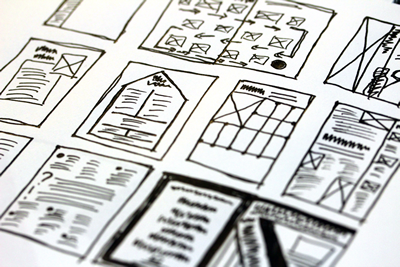
A preliminary, small, quick, unrefined drawings of your ideas. The idea is to get a multitude of variations on paper quickly. The more time you spend on any one sketch, the more precious it becomes. The more precious it becomes, the less you think about possible variations. Check here for some Google Image examples
SUPER TRUE!
Sketching with a hand tool [like a pencil] fosters exploring, problem finding, visual thinking and discovering
Step 2: Roughs
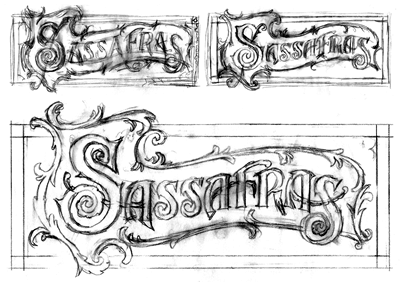
Larger and more refined than thumbnails (above are two thumbnails with a larger rough beneath). Check here for some Google Image examples.
If it doesn't work as a successful design in the rough stage, go back to thumbs.
Tip: Wait a day before going to the next step, Comprehensives (Comps)
Step 3: Comprehensives (Comps)

A detailed representation of a design concept thoughtfully visualized and composed for presentation to the client. Comps usually look like a printed or finished piece.
Meant to be an accurate representation of the final design. Type, illustrations, photographs, and composition are rendered closely enough to the desired finished design to convey an accurate impression of the final piece. Every aspect of typography should be addressed.
Step 4: Client Review

The comp is reviewed. They love it, they hate it—who's to say. But say they will. This is why we use greeking for body copy, clients will often focus on the least important thing and fail to see the bigger picture.
In any case, the client and you will use the comp as a legal document, with the final product as the ultimate deliverable.
Phase 5: Implementation
Production
Sometimes called Digital PrePress, means means gathering the photos, proof-reading, finalizing and getting sign-off on the copy/text (here's some good tricks), and assembling the inDesign files for the printer, then working with the printer all the way through getting the paper off the press and approving pages along the way (called the Press Check).
Craftsmanship
The level of skill in execution. Includes:
- For Print Design, you need skills in:
- Photoshop
- Illustrator
- InDesign
- Photography
- Copywriting
- Knowledge of types of inks, papers, and printing processes
- For Web Design, you need skills in:
- Dreamweaver
- Photoshop
- Photography
- Copywriting
- HTML
- CSS
- JavaScript
- jQuery
- PHP
- mySQL
- Knowledge of the latest cutting-edge technologies in Web Design
Design solutions should be neat, clean, accurate, functional, and ecologically mindful. It can make or break a job interview.